Stop Coding Harder: 10 Behaviors That Move Junior Engineers to Mid-Level
Originally published on Medium. Read here free — no account needed.
The jump from junior to mid-level isn’t a coding problem. It’s a behavior problem.
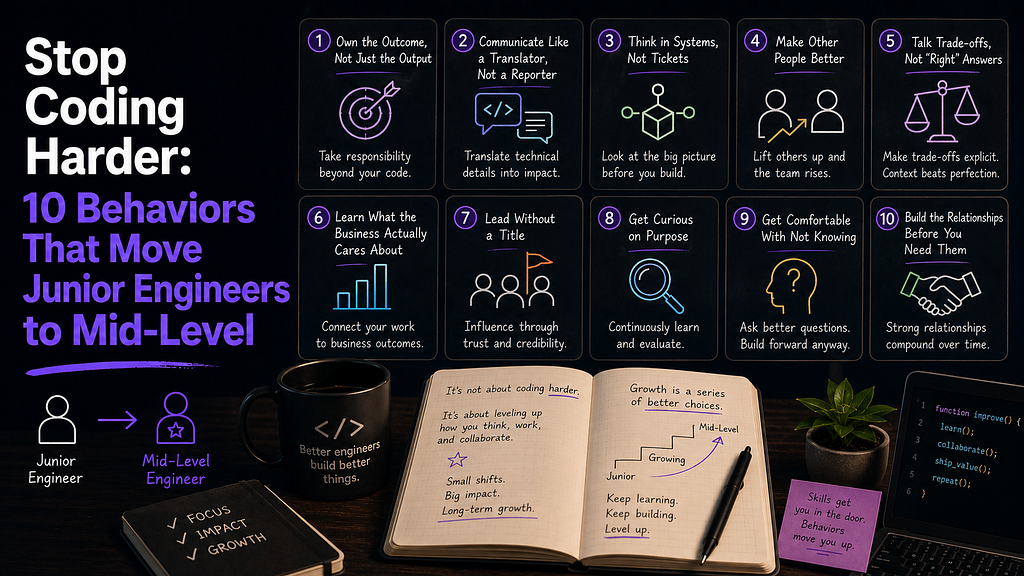
You’ve been writing code professionally for two years. You ship features. You close tickets. Your code reviews come back cleaner every quarter. So why are you still labeled “junior” while someone who joined six months after you just got bumped to mid-level? 🤔
It’s not the code. The junior-to-mid-level transition is behavioral, not technical, and most engineers stuck in junior roles in 2026 are stuck because they’re trying to out-code their way past a problem that has nothing to do with code.
This guide is the 10 behaviors that actually move the needle. Hiring managers and senior engineers watch for these when deciding who’s ready. Skills get you hired. These get you promoted.
Why “Code Better” Isn’t the Answer
Mid-level engineers aren’t mid-level because they know more syntax. They’re mid-level because they multiply their team’s output instead of just adding to it.
Think of it like driving. Juniors drive in empty parking lots. They enjoy clear requirements, immediate feedback, one variable at a time. Mid-level engineers drive in rush-hour traffic. They navigate shifting priorities, competing stakeholders, decisions that ripple for months.
If you’ve ever wondered why a slightly-less-skilled coworker got promoted before you, here’s your answer. Master these 10 behaviors and the gap closes fast.
1. Own the Outcome, Not Just the Output
Junior engineers ship code. Mid-level engineers ship results.
When something breaks in production, the junior reaction is “my code worked in staging.” The mid-level reaction is “what’s our path to making sure this doesn’t happen again?” That’s not semantics. It’s the entire difference in how you’re perceived.
Follow your work after deployment. Watch the logs. Check the metrics. When you spot a problem, show up with a fix proposal, not just a bug report.
2. Communicate Like a Translator, Not a Reporter
Once you’re past junior, the people you work with stop being mostly engineers. You’ll be talking to PMs, designers, leadership, and sometimes customers, and they don’t speak your language.
Stop saying “this code is messy and needs refactoring.” Start saying “this module is the source of 40% of our bugs, and cleaning it up would cut our bug rate and speed up the next two features.”
Same technical content. Wildly different reception. Reports describe activity while translators describe impact.
3. Think in Systems, Not Tickets
Juniors think at the ticket level. Mid-level engineers think at the system level.
Before you start coding, ask: How does this affect the database under load? What breaks if we 10x traffic tomorrow? Does this change how we deploy? Who downstream depends on this contract?
You don’t need to have every answer. You just need to be the person who asks the questions before someone more senior has to. 💡
4. Make Other People Better
The single most reliable signal that you’re ready for mid-level isn’t your code. It’s whether other engineers get better when they work with you.
You don’t need to be the most senior person on the team to do this. Write the doc your past self would’ve killed for. Leave thoughtful code review comments that explain the why. Pair with the new hire when nobody asked you to.
When you make others more effective, you’re proving you can be trusted with a larger sphere of influence. That’s promotion math.
5. Talk Trade-offs, Not “Right” Answers
Junior engineers want the right answer. Mid-level engineers know there usually isn’t one.
Every real-world decision is a trade-off: speed versus correctness, simplicity versus flexibility, today’s velocity versus tomorrow’s debt. The mid-level move is to name the trade-off out loud.
“We can ship this in two days with a known scaling cliff at 5k users, or take a week and not have to revisit it for a year.” That’s the kind of framing teams trust. “It depends” without the follow-up isn’t.
6. Learn What the Business Actually Cares About
You will not get promoted by being a better coder in isolation. You’ll get promoted by being a better coder who also understands what the company is trying to do.
Sit in on product reviews. Read the customer support tickets. Know which metrics your team is judged on. Find out what “good enough” looks like, because sometimes “good enough” is the right answer, and engineers who can’t see that get stuck building gold-plated solutions to bronze-tier problems.
The engineers who connect technical choices to business outcomes are the engineers who get the next slot opened up.
7. Lead Without a Title
Mid-level doesn’t come with reports, but it does come with influence. You’ll need to nudge teammates toward better testing practices, rally a cross-team effort, or push back on a design that’s going to bite the team in three months.
You can’t do that by ordering people around. You don’t have the authority. You do it by being the person whose ideas are obviously good, whose track record is solid, and who builds consensus instead of demanding it.
If you can move a project forward without a title, you’ve already started being mid-level. The title just catches up.
8. Get Curious on Purpose
The industry moves fast. New frameworks, new tools, new “best” practices every month. Juniors either chase every shiny thing or ignore it all. Mid-level engineers do something harder: they evaluate.
Build a habit of asking three questions about anything new: What problem does this actually solve? Is that a problem we have? Is the trade-off worth it for our context?
Stay current on the fundamentals that transfer: system design, data modeling, debugging instincts. Be skeptical of trends. Open source contributions, conference talks, and active community engagement compound your learning faster than any course will.
9. Get Comfortable With Not Knowing
Juniors get specs. Mid-level engineers get vague problem statements and a deadline.
“Make checkout faster” isn’t a ticket. It’s a starting point. The mid-level skill is breaking the ambiguous into the actionable. Ask the questions that surface the hidden assumptions. Run small experiments instead of trying to design the perfect solution upfront.
The engineers who freeze when requirements are unclear stay junior. The ones who can take “we need to fix this somehow” and turn it into a three-week plan move up. ✨
10. Build the Relationships Before You Need Them
Engineering is a team sport, and the team is bigger than you think. PMs, designers, infra, support, sales: every one of them either makes your job easier or harder based on how you treat them.
Invest in those relationships before you need a favor. Learn enough about product, design, and ops to talk shop with them. The mid-level engineer who has a good relationship with the support lead gets bugs triaged faster. The one who knows the data team gets metrics dashboards built faster.
It’s not politics. It’s just how work actually happens.
How to Make This Stick
Don’t try to fix all ten at once. Behavioral change isn’t a sprint. It’s a habit graft, and you can only graft a couple at a time.
Pick the two that feel furthest from where you are right now. Build them into your week. If communication is the weak spot, write a status update every Friday and force yourself to focus on impact, not activity. If systems thinking is the gap, sketch the architecture before you write the first line of every new feature.
The point isn’t to perform “mid-level engineer” until someone notices. The point is to actually become someone whose teams are better because they showed up. Promotion is a lagging indicator of that, never a leading one.
Frequently Asked Questions
How long does the junior-to-mid-level jump usually take?
Most people make it in 2–4 years, but the calendar isn’t the point. You’re ready when you’re consistently doing the things above, not when you’ve hit a year count.
What if my current job doesn’t give me room to practice these?
Create the room. Volunteer for the cross-team project nobody wants. Write the doc that’s missing. Run the post-mortem nobody scheduled. If you’ve genuinely exhausted the surface area at your current company, that’s a useful data point for your next move.
How do I know I’m actually ready for promotion?
You’re ready when your teammates already treat you like you’re mid-level: when people bring you problems, defer to your judgment on trade-offs, and look to you in ambiguous situations. Promotion should recognize a pattern you’re already living, not bet on potential you haven’t shown.
Which of these ten do you already do, and which one are you avoiding? Drop it in the comments. The one you don’t want to talk about is probably the one to start with.